Middle East War: Impact on Indian Exports
The conflict and instability in the Middle East can seriously affect Indian exports because the region is one of India’s most important trade partners. India exports petroleum products, food items, textiles, engineering goods, chemicals, machinery, electronics, gems & jewelry, and many other products to countries like United Arab Emirates, Saudi Arabia, Qatar, Kuwait, Iraq, and Israel.
5/12/20263 min read
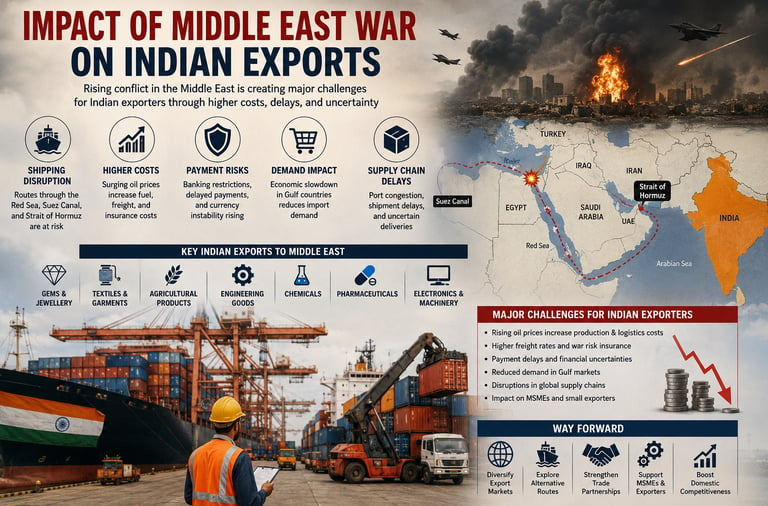
A major war in the Middle East creates disruption in shipping, oil prices, insurance costs, trade routes, and payment systems. Here is a detailed explanation of how Indian exports are affected.
1. Importance of the Middle East for India
The Middle East is strategically important for India because:
A large share of India’s crude oil and gas imports comes from this region.
Millions of Indians work in Gulf countries and send remittances back to India.
Gulf nations are major buyers of Indian products.
Important global shipping routes pass through the region.
Major trade routes include:
Strait of Hormuz
Red Sea
Suez Canal
If war affects these routes, Indian exports face delays and higher costs.
2. Shipping Route Disruption
One of the biggest dangers during war is disruption of maritime transport.
Strait of Hormuz Risk
Around one-fifth of global oil trade passes through the Strait of Hormuz. If military conflict blocks or threatens this route:
Cargo ships may avoid the area.
Freight rates rise sharply.
Delivery times become unpredictable.
Exporters face cancellation of orders.
Indian exporters to Europe and Gulf countries may need longer alternate routes.
3. Increase in Freight and Insurance Costs
War zones are considered “high-risk areas.”
As a result:
Marine insurance premiums increase.
Shipping companies charge “war risk surcharge.”
Container rates become expensive.
This reduces the competitiveness of Indian exports.
Example:
A textile exporter from India sending goods to Dubai may suddenly face:
Higher shipping charges
Delayed cargo
Additional insurance costs
Profit margins fall significantly.
4. Rise in Crude Oil Prices
India imports most of its crude oil. Middle East conflict usually pushes global oil prices upward.
Higher oil prices affect:
Transportation costs
Manufacturing costs
Electricity costs
Packaging and logistics
This indirectly increases the price of Indian exported goods.
Industries heavily affected:
Chemicals
Plastics
Fertilizers
Engineering goods
Textile manufacturing
5. Impact on Specific Indian Export Sectors
A. Gems and Jewelry
India exports large quantities of gold jewelry and diamonds to Gulf nations.
War reduces:
Consumer spending
Luxury purchases
Retail demand
Jewelry exports may decline sharply.
B. Textile and Garments
The Gulf market imports:
Indian garments
Home textiles
Fashion products
Economic uncertainty during war reduces retail demand.
Small exporters suffer because:
Orders get postponed
Buyers delay payments
Inventory remains unsold
C. Food and Agricultural Exports
India exports:
Rice
Tea
Spices
Sugar
Meat products
Conflict may:
Disrupt port operations
Delay customs clearance
Create food security restrictions
However, in some situations demand for essential food products can also rise temporarily.
D. Engineering and Machinery
Construction and infrastructure projects often slow during regional instability.
This affects Indian exports of:
Machinery
Electrical equipment
Steel products
Auto components
6. Payment and Banking Problems
War can create:
Currency instability
Banking restrictions
International sanctions
Indian exporters may face:
Delayed payments
Non-payment risks
Difficulty in opening Letters of Credit (LC)
This creates cash flow problems for exporters.
7. Impact on Small and Medium Exporters
Large corporations can manage temporary disruptions better than smaller exporters.
MSME exporters often face:
Working capital shortages
Shipment delays
Order cancellations
Currency losses
For many small Indian exporters, even a few delayed payments can create severe financial stress.
8. Effect on Indian Ports and Logistics
Indian ports connected with Middle East trade may experience:
Congestion
Container shortages
Shipping schedule disruptions
Important Indian ports affected may include:
Mumbai
Mundra
Kochi
Chennai
9. Currency Fluctuation
War creates volatility in:
US Dollar
Oil prices
Emerging market currencies
If the Indian Rupee weakens:
Imports become expensive
Exporters may gain temporarily in currency conversion
But raw material costs increase
The benefit is often limited because production costs also rise.
10. Global Economic Slowdown
A prolonged Middle East war can slow global economic growth.
Consequences:
Lower international demand
Reduced investment
Falling consumer spending
Indian exporters may lose orders not only from Gulf countries but also from Europe and Africa.
11. Opportunities for India During Crisis
Sometimes crises also create opportunities.
India may benefit through:
Increased food exports
Alternative supplier opportunities
Higher demand for pharmaceuticals
New trade partnerships
For example, if other exporting countries face disruption, Indian suppliers may fill the gap.
Indian pharmaceutical exports often remain strong because medicines are essential products.
12. Government Measures India May Take
The Indian government may respond through:
Export incentives
Alternative shipping routes
Strategic oil reserves
Diplomatic negotiations
Trade diversification
Organizations involved:
Federation of Indian Export Organization's
Ministry of Commerce and Industry
Reserve Bank of India
13. Long-Term Strategic Concerns
If instability continues for years:
Companies may shift supply chains
Export markets may diversify
India may increase trade with Southeast Asia and Africa
Energy security becomes more important
India may also invest more in:
Renewable energy
Domestic manufacturing
Alternative transport corridors
14. Overall Conclusion
Middle East wars create major uncertainty for Indian exports because the region is deeply connected to India’s:
Energy security
Shipping routes
Overseas trade
Financial flows
The biggest risks are:
Rising oil prices
Shipping disruption
Higher freight and insurance costs
Delayed payments
Reduced demand in Gulf markets
Quality
Crafting genuine leather bags for global markets and local market also.
Contact
Support
santirsilpa2014@gmail.com
Call/ Whatsapp-
+919831547090
© 2024. All rights reserved.
+918420525534
craftindia2025@gmail.com
For any business inquiry or any order please contact us.
Craft India a part of Santir Silpa
Email us-